
Employment
Employers have a duty under the Equalities Act to ensure that the needs of their autistic employees are being met, this includes all aspects of the job whether it is around sensory issues or what the job itself entails.
The Equality Act’s definition of disability is quite wide so you might be disabled under the Equality Act even if you don’t see yourself as disabled - for example if you are Autistic, ADHD or have a long-term illness, you will be defined as being disabled under the Act.
You can check the Equality Act 2010’s definition of disability here
Reasonable adjustments at work for autistic peopleEmployers are required to offer reasonable adjustments for employees as per their duty under the Act. Reasonable adjustments can help you to:
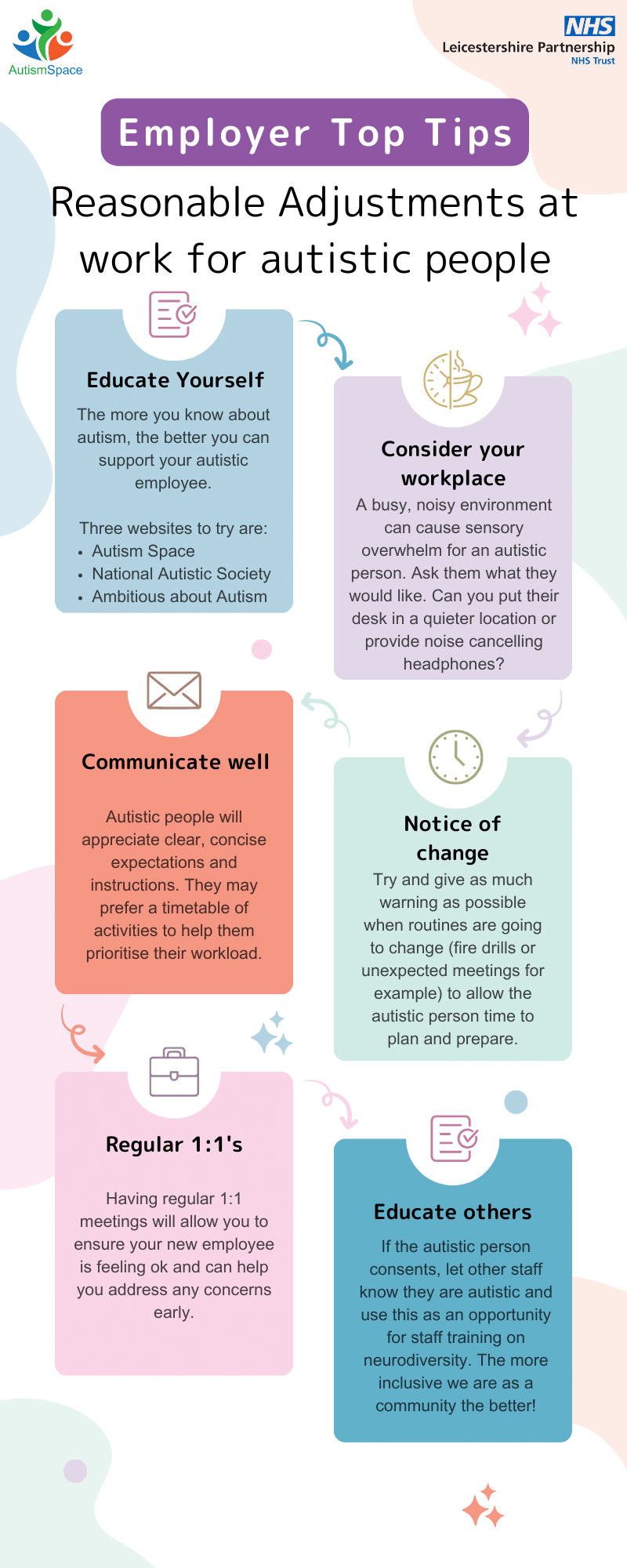
Leicester NHS Trust list an aide of examples of what reasonable adjustments might look like here. This includes headphones, apps and flexible working. They have also designed an Employer top tips reasonable adjustment poster (PDF) that you can share with your HR or Manager. Health Adjustment Passports are also available on the GOV UK site here. |
|
How to ask for reasonable adjustmentsThere are different ways to approach this, but one way is to simply ask your manager for a meeting. Ask for a meetingReasonable adjustments can be requested at any time. If you feel you are struggling and finding every day activities harder, don't delay, reach out to your manager for a meeting. If your manager is not aware you are autistic, take in some evidence. This can be a letter from the Autism Diagnostic Service when you were first diagnosed or ask your GP for a letter. You do not need to share any details about your diagnosis, only share what you are comfortable with. Once you have your manager and organisation on your side it's easier to ask for reasonable adjustments. After outlining your struggles with your manager, you can suggest completing an Employment Checklist as a starting point to help identify what your needs are in a systematic format. More details about the Checklist can be found below. There are also national and local support available, including:Apply for an Access to Work GrantIdeally an Access to Work Grant should be accessed at the start of your employment journey, however you can still apply once you are in post and later find you are struggling (there may however be a time delay in accessing this grant). An Access to Work Grant offers a varied support package, depending on your needs, and can be worth thousands of pounds. e.g. IT equipment & software, work coaches and so much more. If you get an Access to Work Grant, it will not affect any other benefits you get and you will not have to pay it back. You or your employer may need to pay some costs up front and claim them back later. You can apply for Access to Work online or by phone 0800 121 7479 Support Available Through the Department for Work and Pensions (DWP)The Department for Work and Pensions offers support to help people with health conditions or disabilities stay in work or return to employment. Disability Employment Adviser (DEA) Every Jobcentre Plus has a Disability Employment Adviser who can:
They work alongside Jobcentre work coaches to make sure support is tailored to your needs. WorkWell WorkWell supports people who are:
It offers early, personalised health and employment advice to help you remain in or return to work. Jobcentre Plus Support Work coaches can provide:
Flexible Support Fund (FSF) Work coaches can use this fund to help with:
This support helps remove barriers so people can stay in work Contact your local DWP office to find out more. Our Newham WorkOur Newham Work have a specialist team supporting autistic people to access and sustain employment. Contact Our Newham Work to find out what advice and support they can offer. Download the Leicester NHS Trust pdf here for more details around the first two approaches |
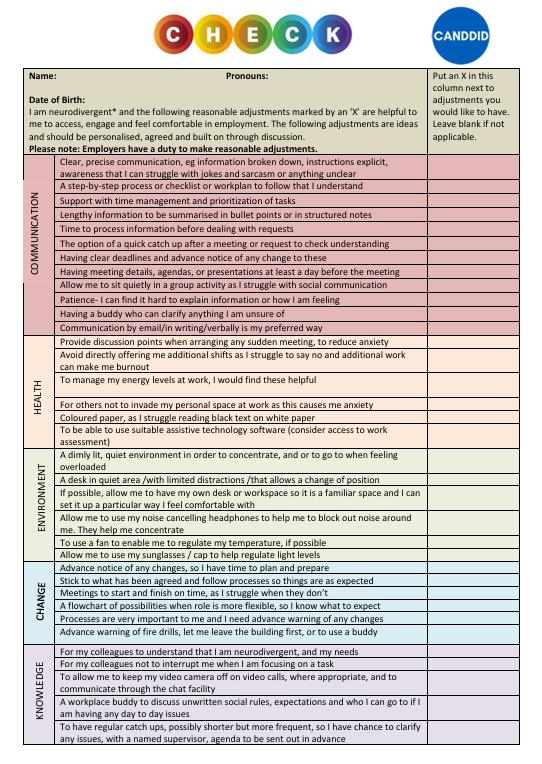
Employment ChecklistCheshire NHS Trust have designed a checklist to help you consider what adjustments might support you at work. Complete the checklist and discuss this with your support networks and then talk this through with your Manager. The checklist focuses on five main areas:
Download the employment check document here. |
 |
What to do if you have been refused reasonable adjustments?Citizens Advice state 'The Equality Act is the law that says when people and organisations have to make changes so disabled people aren’t disadvantaged. It calls this the duty to make reasonable adjustments'. Read more about what steps you can take here: If you've been refused reasonable adjustments - Citizens Advice |
Understanding AutismIf your manager is not familiar with what it means to be autistic, please share with them the resources on our pages here Support & Information for Autistic Residents – Autism – Newham Council and the NAS pages - What is autism |
Work Coaching Opportunity for Autistc Adults
If you’re autistic, living in Newham and currently working, this is a fully funded opportunity for workplace support.
You can sign up here: Registration form: Work coaching group for Autistic people (online) or use the QR code shown on the video below.
We interviewed six autistic people who live or work in Newham to find out what their experiences are as an autistic person and the minor adjustments needed to support them to remain in employment.
Feel free to share the resources above with your HR team or Manager or use this information for yourself as a guide.
We wish to formally acknowledge the Leicester and Cheshire NHS Trusts for the use of their published materials.
